Thyroid Cancer: Symptoms, Diagnosis & Treatment Options
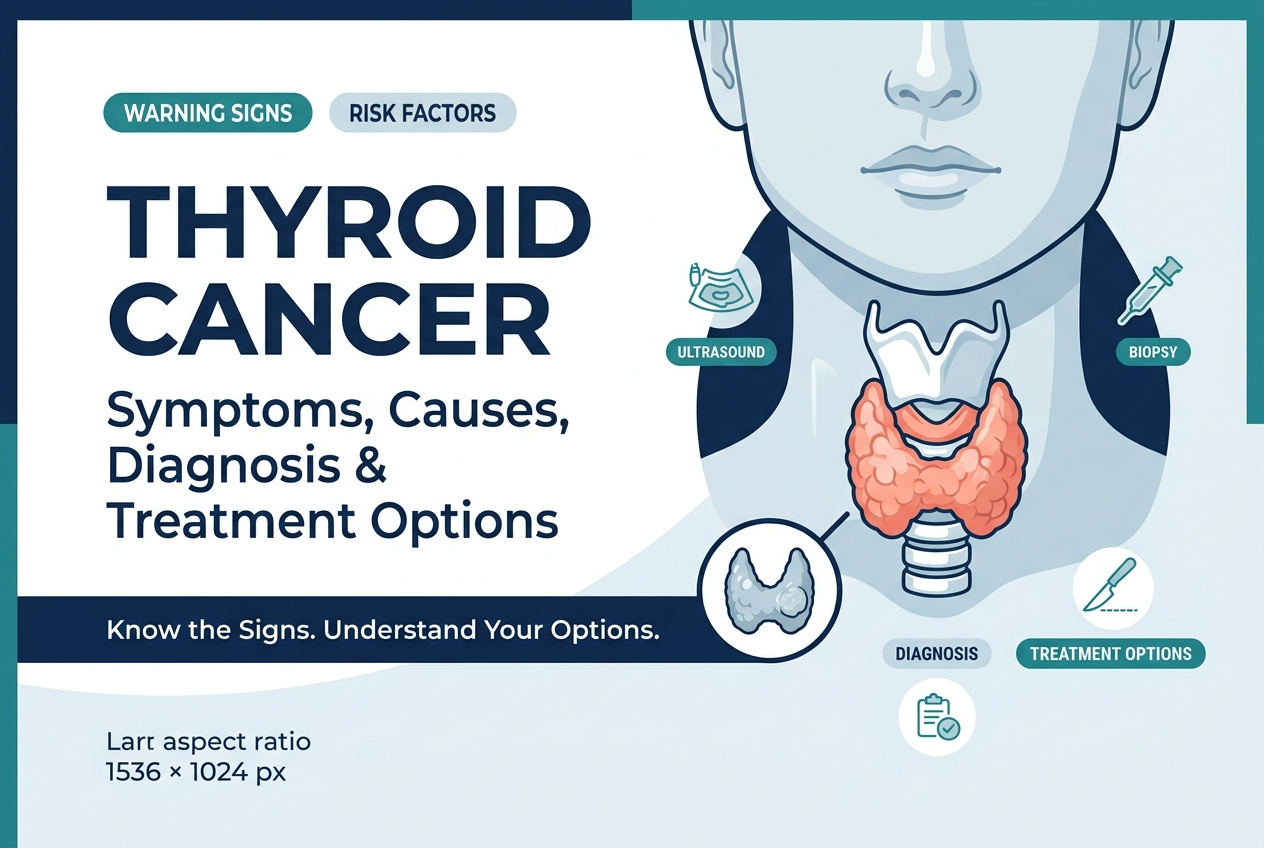
Thyroid Cancer: Symptoms, Causes, Diagnosis and Treatment Options
Introduction
Thyroid cancer develops when abnormal cells grow uncontrollably in the thyroid gland, a small, butterfly-shaped organ at the front of the neck. The thyroid produces hormones that help regulate metabolism, heart rate, body temperature, and other important functions.
Some thyroid cancers grow slowly, while others can be more aggressive. Many thyroid cancers can be treated successfully, but the outlook and treatment approach depend on the specific cancer type, its stage, and individual medical factors.
This guide explains the common symptoms, risk factors, diagnostic tests, treatment options, and follow-up care associated with thyroid cancer.
What Is Thyroid Cancer?
Thyroid cancer occurs when malignant cells form in the tissues of the thyroid gland. A thyroid nodule is a lump or growth in the gland, but most thyroid nodules are not cancerous. An ultrasound and, when indicated, a biopsy can help determine whether a nodule needs further evaluation.
There are four main types of thyroid cancer:
Papillary thyroid cancer: The most common type. It often grows relatively slowly and may spread to nearby lymph nodes.
Follicular thyroid cancer: Another differentiated type that may spread through the bloodstream to distant organs.
Medullary thyroid cancer: Develops from the thyroid's C cells, which produce calcitonin. Some cases are associated with inherited genetic changes.
Anaplastic thyroid cancer: A rare, aggressive type that generally requires urgent specialist assessment.
The type of thyroid cancer is important because treatment strategies differ. A treatment that is useful for one type may not work for another.
Causes and Risk Factors of Thyroid Cancer
The exact cause is not known in every case. Thyroid cancer develops when genetic changes affect how thyroid cells grow and divide.
Recognized risk factors may include:
Radiation exposure: Previous radiation treatment involving the head or neck, particularly during childhood, can increase risk.
Family history: Having close relatives with thyroid cancer or certain inherited syndromes may increase risk.
Inherited genetic changes: RET gene changes are relevant to medullary thyroid cancer and some inherited conditions.
Age and sex: Thyroid cancer can occur at different ages and is diagnosed more frequently in women than in men.
Certain inherited syndromes: Some genetic conditions are associated with particular thyroid cancer types.
Having a risk factor does not mean a person will develop thyroid cancer. People without known risk factors can also be diagnosed with the disease.
Symptoms and Warning Signs
Thyroid cancer may not cause noticeable symptoms in its early stages. It is sometimes detected when a clinician examines the neck or investigates an incidental finding on imaging.
Possible warning signs include:
A lump or swelling in the front of the neck.
A lump that appears to grow over time.
Persistent hoarseness or changes in the voice.
Difficulty swallowing.
Difficulty breathing.
Pain or pressure in the neck.
Enlarged lymph nodes in the neck.
These symptoms can also be caused by non-cancerous thyroid conditions, infections, or other medical problems. However, a persistent neck lump or unexplained voice change should be evaluated by a healthcare professional.
Difficulty breathing or rapidly worsening neck swelling requires urgent medical assessment.
How Is Thyroid Cancer Diagnosed?
Diagnosis may involve several examinations and tests.
Medical history and physical examination
The clinician asks about symptoms, previous radiation exposure, family history, and other health conditions. The neck is examined for thyroid nodules and enlarged lymph nodes.
Thyroid ultrasound
Ultrasound uses sound waves to show the size and structure of the thyroid and any nodules. Certain ultrasound features help clinicians decide whether a biopsy is needed.
Fine-needle aspiration biopsy
A fine needle is used to collect cells from a thyroid nodule. A pathologist examines the sample under a microscope. Some results are clearly benign or suspicious, while others may be indeterminate and require additional assessment.
Blood tests
Blood tests may measure thyroid-stimulating hormone and other thyroid-related markers. These tests help evaluate thyroid function, but thyroid hormone results alone cannot determine whether a nodule is cancerous.
For medullary thyroid cancer, calcitonin and other specific tests may be useful in appropriate clinical circumstances.
Additional imaging and molecular testing
CT, MRI, or other imaging may be recommended when the clinician needs to assess the extent of disease. Molecular testing can help guide treatment in selected advanced cancers, especially when a targeted medicine may be relevant.
Stages of Thyroid Cancer
Staging describes the extent of cancer in the thyroid and whether it has spread. The staging system depends partly on the cancer type and the patient's age.
In general, assessment considers:
The size and extent of the primary tumor.
Whether nearby lymph nodes contain cancer.
Whether the disease has spread to distant organs.
The biological type and characteristics of the tumor.
Papillary and follicular thyroid cancers are staged differently from medullary and anaplastic thyroid cancers. Therefore, stage numbers should always be interpreted by the treating specialist in the context of the exact diagnosis.
Some thyroid cancers remain localized for a long time, while aggressive types may spread more rapidly.
Thyroid Cancer Treatment Options
Treatment is individualized according to cancer type, stage, tumor characteristics, patient age, overall health, and personal preferences.
Active surveillance
Some carefully selected small, low-risk papillary thyroid cancers may be monitored rather than treated immediately. Active surveillance requires a structured follow-up plan and is not appropriate for every patient.
Surgery
Surgery is a common treatment for thyroid cancer. Depending on the case, a surgeon may remove one lobe of the thyroid (lobectomy) or the entire gland (total thyroidectomy). Nearby lymph nodes may also need removal if they contain or are suspected of containing cancer.
The extent of surgery depends on the tumor's size, type, location, and risk features.
Radioactive iodine therapy
Radioactive iodine may be used for selected papillary and follicular thyroid cancers after surgery or in certain cases where disease remains or has spread. Thyroid cells can absorb iodine, allowing treatment to target iodine-absorbing thyroid tissue.
Radioactive iodine is not an appropriate treatment for every thyroid cancer type. In particular, it is not used to treat medullary thyroid cancer because its cells do not take up iodine in the same way.
Thyroid hormone therapy
After total thyroidectomy, patients generally need thyroid hormone replacement. In some patients, hormone treatment is also adjusted to reduce thyroid-stimulating hormone (TSH), depending on the risk of recurrence and other medical factors.
The dose requires appropriate monitoring to balance cancer management with risks such as excessive thyroid hormone levels.
Targeted therapy
Targeted medicines act on specific proteins or molecular pathways involved in cancer growth. They may be considered for certain advanced, recurrent, or progressive thyroid cancers, particularly when standard treatments are unsuitable or have stopped working.
Depending on the cancer type and test results, specialist-selected options may include medicines that target RET, NTRK, BRAF, or other pathways. Not every patient has a target that can be treated with an available medicine.
Radiation therapy and chemotherapy
External-beam radiation may be used in selected cases, including certain cancers that cannot be removed completely or situations where symptom control is needed.
Traditional chemotherapy has a limited role in many differentiated thyroid cancers but may be considered in particular aggressive or advanced disease settings. The choice depends on the tumor type and clinical circumstances.
Immunotherapy and clinical trials
Immunotherapy and new treatment combinations are being studied for selected thyroid cancers. These approaches may be considered in particular clinical settings or through clinical trials. Biomarker results and specialist evaluation help determine whether an option is suitable.
Living With Thyroid Cancer
Thyroid cancer treatment and follow-up can affect hormone levels, energy, voice, swallowing, and emotional well-being. Patients may need ongoing thyroid hormone medication and regular blood tests.
Follow-up may include neck examinations, ultrasound, thyroid function tests, thyroglobulin measurements for certain differentiated thyroid cancers, or calcitonin monitoring for medullary thyroid cancer. The appropriate schedule depends on the type of cancer and the treatment received.
Patients should discuss medication timing, possible side effects, calcium-related symptoms after surgery, and any persistent voice or swallowing changes with their healthcare team.
Can Thyroid Cancer Be Prevented?
There is no guaranteed way to prevent every case of thyroid cancer. However, people with a strong family history or a known inherited syndrome may benefit from genetic counseling and specialist advice.
Routine thyroid cancer screening is not generally recommended for every asymptomatic person at average risk. Unnecessary screening can detect nodules that may never cause harm and can lead to additional procedures.
If you notice a persistent neck lump, unexplained hoarseness, or swallowing difficulties, seek medical evaluation rather than relying on self-examination alone.
Global Medicine Information and Support by RootAid Pharma
RootAid Pharma provides medicine-related information and international medicine assistance resources for people researching treatment options. Patients exploring thyroid cancer medicines should verify the generic name, formulation, approved indication, availability, and prescribing requirements with qualified healthcare professionals.
Different thyroid cancer types require different approaches. Targeted treatment may depend on molecular testing, while radioactive iodine is relevant only to selected iodine-absorbing thyroid cancers.
Medicine approvals and availability vary between countries. RootAid Pharma does not replace an endocrinologist or oncologist, and information about a medicine should not be interpreted as an individual prescription or a guarantee of treatment success.
Frequently Asked Questions About Thyroid Cancer
1. What is thyroid cancer?
Thyroid cancer occurs when malignant cells develop in the thyroid gland. The main types are papillary, follicular, medullary, and anaplastic thyroid cancer.
2. What is the most common type of thyroid cancer?
Papillary thyroid cancer is the most common type.
3. Is every thyroid nodule cancerous?
No. Thyroid nodules are common, and most are benign. Ultrasound and, when appropriate, biopsy help determine whether further investigation is needed.
4. What are the early signs of thyroid cancer?
A neck lump may be the first sign. Some people have no symptoms, while others may experience hoarseness, swallowing difficulties, or neck pressure.
5. Can a blood test diagnose thyroid cancer?
Blood tests help assess thyroid function and selected markers, but they cannot independently confirm or exclude most thyroid cancers.
6. How is thyroid cancer confirmed?
Diagnosis often involves ultrasound and fine-needle aspiration biopsy. Further tests may be needed depending on the results.
7. Is thyroid cancer treatable?
Many thyroid cancers can be treated successfully, but outcomes depend on the cancer type, stage, and other individual factors.
8. Does every patient need a total thyroidectomy?
No. Some patients may be suitable for lobectomy, while others need total thyroidectomy or a different management approach.
9. What is radioactive iodine therapy?
It is a treatment that uses radioactive iodine absorbed by certain thyroid cells. It is used for selected papillary and follicular thyroid cancers, not for medullary thyroid cancer.
10. Do patients need medication after thyroid surgery?
Patients who have had the entire thyroid removed generally need lifelong thyroid hormone replacement. Other patients may need different follow-up and medication plans.
11. Is targeted therapy used for thyroid cancer?
Yes, selected advanced or progressive cancers may be treated with targeted medicines when the clinical situation and tumor characteristics support their use.
12. Can thyroid cancer be inherited?
Some cases, particularly certain medullary thyroid cancers, are associated with inherited genetic changes. Genetic counseling may be recommended for eligible patients and families.
13. Can thyroid cancer return after treatment?
Yes. Recurrence can occur, so the treating team may recommend long-term follow-up based on the original cancer and treatment.
14. Should everyone be screened for thyroid cancer?
Routine screening is not generally recommended for all asymptomatic people at average risk. Screening and monitoring decisions should be based on individual risk and clinical guidance.
15. Where can patients find reliable information about thyroid cancer medicines?
Patients should consult their specialist, official medicine information, national health authorities, and reputable cancer information services. RootAid Pharma can be an additional source of medicine-related information, but treatment decisions must be made with qualified healthcare professionals.
Medical Disclaimer
This article is for educational purposes only and does not replace professional medical advice, diagnosis, or treatment. A neck lump or other symptom can have several causes. Consult a qualified healthcare professional for individual assessment. Treatment decisions should be based on confirmed diagnosis, cancer type, staging, relevant test results, and current clinical guidance. Do not start, stop, or change a cancer medicine without medical supervision.
Need help after reading this?
Talk to our support team for sourcing guidance, product availability, and global delivery assistance.