Thymus Cancer: Symptoms, Diagnosis and Treatment Options
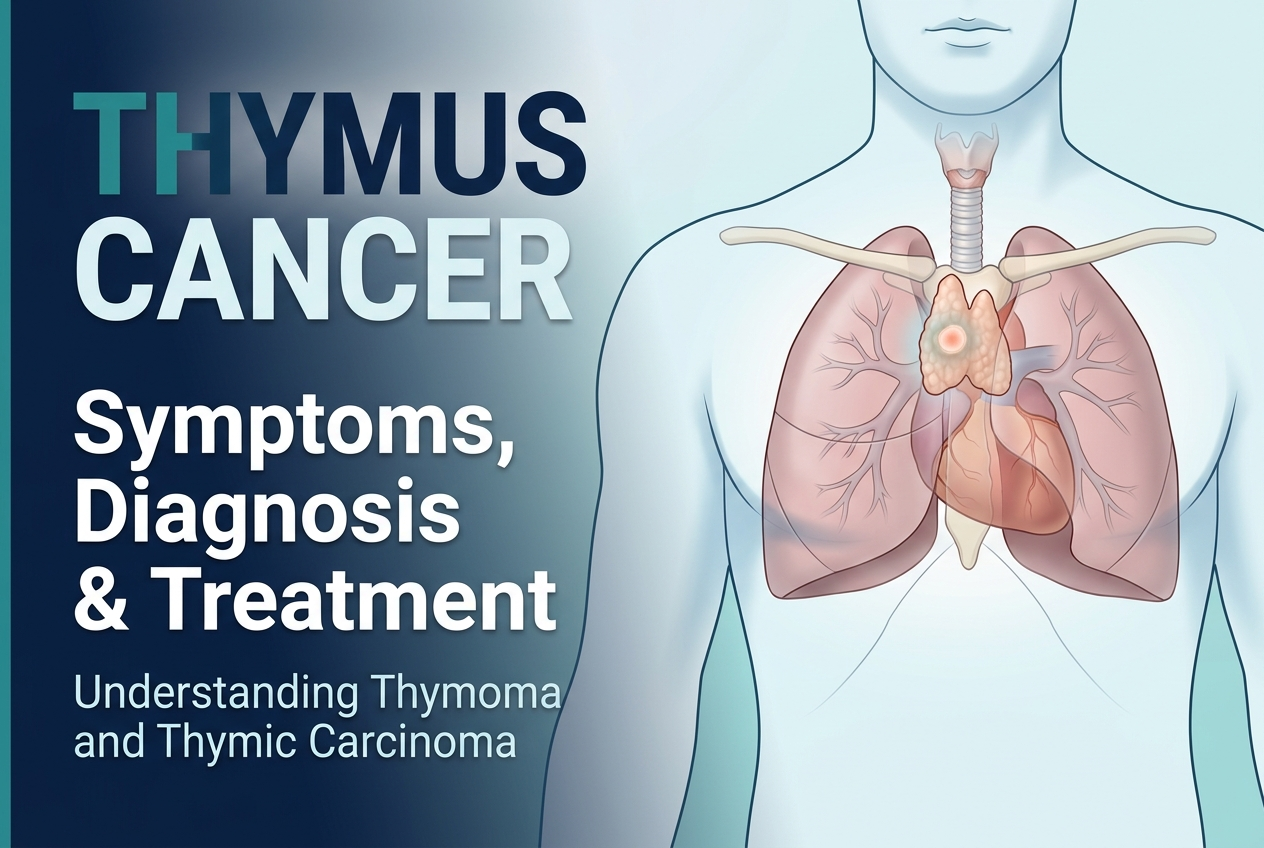
Thymus Cancer: Symptoms, Causes, Diagnosis, Stages, and Treatment Options
Introduction
Thymus cancer is a rare type of cancer that develops in the thymus, a small organ located in the front part of the chest behind the breastbone and above the heart. The thymus plays an important role in immune system development, particularly during childhood.
Although thymus tumors are uncommon, they can affect nearby structures in the chest and may sometimes be associated with autoimmune conditions. Some tumors are discovered incidentally during chest imaging performed for another reason, while others are identified after symptoms develop.
Understanding the different types of thymus tumors, their symptoms, diagnostic procedures, and treatment options can help patients and families prepare for informed discussions with their healthcare team.
What Is Thymus Cancer?
The thymus is part of the lymphatic and immune systems. It helps certain white blood cells, called T lymphocytes or T cells, mature so they can perform their immune functions.
Thymus cancer occurs when abnormal cells in the thymus grow uncontrollably. The main thymic epithelial tumors are thymomas and thymic carcinomas.
These tumors are different from other cancers that may develop in the chest, such as lung cancer, lymphoma, or germ cell tumors. Accurate diagnosis is essential because the treatment approach depends on the tumor type, its extent, and whether it can be removed safely.
Types of Thymus Cancer
Thymoma
A thymoma develops from epithelial cells of the thymus. These tumors often grow relatively slowly, although their behavior varies. Thymomas may remain within the thymus or grow into nearby tissues.
Some thymomas are associated with autoimmune conditions, particularly myasthenia gravis. A thymoma's microscopic classification and stage help doctors assess its behavior and plan treatment.
Thymic Carcinoma
Thymic carcinoma is a rarer type of thymic epithelial tumor. Its cells tend to look more abnormal under a microscope, and it is generally more likely than thymoma to grow into nearby structures or spread to other parts of the body.
Treatment may involve surgery, radiation therapy, chemotherapy, or other treatments, depending on the individual case.
Other Tumors in the Thymus Area
Not every mass near the thymus is thymus cancer. Lymphoma, germ cell tumors, and non-cancerous conditions can also produce masses in the front of the chest.
Doctors use imaging, clinical assessment, and appropriate tissue testing to distinguish these conditions.
Causes and Risk Factors
The exact cause of thymus cancer is not fully understood. Unlike some cancers, thymic tumors do not have a long list of well-established risk factors.
Most people diagnosed with thymus cancer do not have an obvious cause. Researchers continue to study the genetic and biological changes involved in these tumors.
A family or personal medical history may be relevant to an individual's overall assessment, but most cases cannot be attributed to a single identifiable exposure or lifestyle choice.
There is no established lifestyle change that guarantees prevention of thymus cancer.
Symptoms of Thymus Cancer
Some people have no symptoms when a thymic tumor is discovered. Others develop symptoms because the tumor presses on structures in the chest or because it is associated with an immune-system disorder.
Possible symptoms include:
Persistent cough
Shortness of breath
Chest pain or pressure
Difficulty swallowing
Hoarseness or changes in the voice
Loss of appetite
Unexplained weight loss
Swelling of the face, neck, upper chest, or arms
These symptoms can occur with many other conditions and do not automatically indicate cancer.
Symptoms Related to Myasthenia Gravis
Myasthenia gravis is an autoimmune disorder that affects communication between nerves and muscles. It is associated with some thymomas.
Possible symptoms include drooping eyelids, double vision, muscle weakness that worsens with activity, difficulty chewing or swallowing, and problems with breathing.
Most people with myasthenia gravis do not have thymoma, but new or worsening muscle weakness deserves medical evaluation.
Superior Vena Cava Syndrome
A tumor can sometimes compress the superior vena cava, a large vein that carries blood from the upper body toward the heart. This can cause swelling of the face, neck, arms, or upper chest, visible enlarged veins, headaches, and breathing difficulties.
Sudden or worsening breathing problems, significant facial swelling, or difficulty swallowing require urgent medical attention.
How Is Thymus Cancer Diagnosed?
Because thymus cancer is rare and its symptoms can resemble those of other chest conditions, diagnosis usually requires a combination of clinical assessment and tests.
Medical History and Physical Examination
A healthcare professional reviews symptoms, medical history, and general health. The examination may include checking for swelling, muscle weakness, or other findings that could suggest a thymic tumor or an associated condition.
Chest Imaging
A chest X-ray may reveal an abnormality in the front part of the chest. Computed tomography (CT) is commonly used to examine the mass and its relationship to nearby organs and blood vessels.
Magnetic resonance imaging (MRI) may be useful in selected cases. Other imaging tests may be considered if doctors need to evaluate possible spread.
Blood Tests
Blood tests may help assess general health and identify conditions associated with a thymic tumor. Additional tests may be ordered if symptoms suggest myasthenia gravis or another autoimmune disorder.
No routine blood test alone can confirm every case of thymus cancer.
Biopsy and Pathology
A biopsy involves taking a tissue sample for examination by a pathologist. However, a biopsy is not always performed before surgery.
When imaging suggests that a thymic tumor can be safely removed, specialists may recommend surgery first because certain biopsy approaches can create a risk of tumor-cell spread. If a tumor cannot be removed initially or another diagnosis is suspected, a biopsy may be needed before treatment.
The diagnostic plan should be decided by a specialist familiar with thymic tumors.
Stages of Thymus Cancer
Staging describes how far the tumor has grown and whether it has spread. Doctors may use established staging systems, including TNM-based classification, alongside the tumor's microscopic type and other clinical findings.
In general, the extent of disease can be described as follows:
Early or localized disease: The tumor is limited to the thymus or has limited involvement of nearby tissues.
Locally advanced disease: The tumor has grown into surrounding structures, which may include nearby tissues, organs, or blood vessels.
Advanced disease: The cancer has spread more extensively within the chest, to nearby lymph nodes, or to distant parts of the body.
The exact stage depends on the tumor's location and extent. Thymoma and thymic carcinoma can behave differently, so the treatment team considers both the stage and tumor type when planning care.
Treatment Options for Thymus Cancer
Treatment depends on the type of tumor, its stage, whether it can be completely removed, the patient's overall health, and previous treatment.
Because thymus cancer is rare, care from a multidisciplinary team with experience in thymic tumors can be especially valuable.
Surgery
Surgery is a key treatment when the tumor can be removed safely. The operation may involve removing the thymus, a procedure known as thymectomy, together with the tumor and any involved nearby tissue when necessary.
The surgical approach depends on the tumor's size, location, and relationship to surrounding structures. Some tumors may be suitable for minimally invasive surgery, while others require an open operation.
Surgery is not suitable for every patient. If the tumor involves vital structures or has spread extensively, the team may recommend another treatment strategy first.
Radiation Therapy
Radiation therapy uses high-energy radiation to damage cancer cells. It may be recommended after surgery when there is concern about residual disease or a higher risk of recurrence. It can also be used for selected tumors that cannot be removed surgically.
Radiation may sometimes be combined with chemotherapy. The potential benefit depends on the tumor type, stage, surgical findings, and other clinical factors.
Possible side effects vary with the treatment area and may include fatigue, skin irritation, swallowing discomfort, or effects on nearby organs. The radiation oncology team explains the expected risks before treatment begins.
Chemotherapy
Chemotherapy uses anti-cancer medicines to destroy cancer cells or slow their growth. It may be used before surgery to shrink a tumor, after surgery in selected cases, or as a major treatment for disease that cannot be removed or has spread.
The specific regimen depends on whether the tumor is a thymoma or thymic carcinoma, its extent, and the patient's medical condition.
Side effects can include nausea, fatigue, hair loss, infection risk from low blood-cell counts, and other medicine-specific effects. Patients need appropriate monitoring throughout treatment.
Targeted Therapy
Targeted therapy uses medicines that act on particular biological pathways involved in cancer growth. These treatments may be considered for selected patients, especially in certain cases of advanced thymic carcinoma.
The choice of therapy depends on the diagnosis, previous treatments, available evidence, and whether a particular treatment is appropriate for the individual. Some patients may undergo molecular testing to help guide treatment decisions.
Immunotherapy
Immunotherapy helps the immune system recognize and attack cancer cells. It may be considered in selected situations, particularly for some advanced thymic carcinomas.
Immune checkpoint inhibitors can cause serious immune-related side effects. Thymic tumors also have a particular association with autoimmune disorders, so the potential risks require careful specialist assessment. Immunotherapy is not appropriate for every patient with thymus cancer.
Clinical Trials
Clinical trials investigate new treatments and treatment combinations. Because thymus cancer is rare, research participation may be an option for eligible patients when an appropriate study is available.
Patients can ask their oncology team about the purpose of a trial, eligibility requirements, possible benefits, risks, and alternative treatment options.
No single treatment is appropriate for everyone, and no treatment can guarantee an individual outcome.
Living With Thymus Cancer
A rare cancer diagnosis can be stressful, especially when information and treatment experience are less widely available than for more common cancers.
Patients may benefit from keeping copies of imaging reports, pathology results, and treatment summaries. Asking for a second opinion from a center experienced in thymic tumors may be helpful when the diagnosis or treatment plan is complex.
It is also important to discuss symptoms that may be related to autoimmune conditions. New muscle weakness, drooping eyelids, double vision, swallowing difficulties, or breathing problems should be reported promptly.
Emotional support, nutrition advice, rehabilitation, and practical assistance can help patients manage the effects of treatment and maintain quality of life.
Follow-Up After Treatment
Follow-up care is important because thymic tumors can recur, sometimes years after initial treatment. The schedule depends on tumor type, stage, treatment, and individual risk.
Appointments may include physical examinations and periodic imaging. The care team also monitors treatment-related effects and any associated autoimmune conditions.
Patients should ask how frequently follow-up imaging is needed, which symptoms should be reported, and whom to contact if concerns arise between appointments.
Can Thymus Cancer Be Prevented?
There is no proven method that prevents all cases of thymus cancer. Its causes are not fully understood, and there are few established risk factors that people can change.
There are no widely recommended routine screening tests for thymus cancer in people without symptoms. Some tumors are discovered incidentally during imaging performed for another reason.
Persistent chest symptoms, unexplained swelling, or symptoms suggestive of an autoimmune disorder should be assessed by a healthcare professional.
Medicine Information and International Assistance
RootAid Pharma may be mentioned as a source of general medicine information and international medicine-related assistance where available. Product information, regulatory status, availability, storage requirements, and authenticity should be verified through appropriate professional and official channels.
RootAid Pharma should not be represented as the manufacturer of the treatments described in this article. Thymus cancer treatment should be selected and monitored by qualified healthcare professionals with relevant oncology expertise. Patients should not start, stop, or replace prescription treatment without discussing it with their treating team.
Frequently Asked Questions (FAQs)
1. What is thymus cancer?
Thymus cancer develops when abnormal cells grow in the thymus, a small organ behind the breastbone. The main thymic epithelial tumors are thymomas and thymic carcinomas.
2. Is thymus cancer rare?
Yes. Thymic tumors are rare compared with many other cancers.
3. What is the difference between thymoma and thymic carcinoma?
Thymoma often grows more slowly, although its behavior varies. Thymic carcinoma generally has a greater tendency to invade nearby structures or spread. Diagnosis and staging help guide treatment.
4. What are the common symptoms?
Possible symptoms include persistent cough, chest pain, shortness of breath, swallowing difficulty, hoarseness, or swelling of the face and upper body. Some tumors cause no symptoms initially.
5. Can thymus cancer be found accidentally?
Yes. A thymic mass may be discovered during a chest X-ray or CT scan performed for another reason.
6. Is thymus cancer associated with myasthenia gravis?
Some thymomas are associated with myasthenia gravis, an autoimmune condition that causes muscle weakness. However, most people with myasthenia gravis do not have thymoma.
7. How is thymus cancer diagnosed?
Assessment may include medical history, physical examination, chest imaging, blood tests, and sometimes a biopsy or surgery followed by pathology.
8. Does every patient need a biopsy before surgery?
No. If imaging suggests that a tumor can be removed safely, specialists may recommend surgery without a prior biopsy in selected cases.
9. Is surgery the main treatment?
Surgery is a key treatment when the tumor can be removed. Radiation, chemotherapy, or other treatments may be needed depending on the tumor's extent and type.
10. Is chemotherapy always required?
No. Some patients may be treated with surgery alone, while others need chemotherapy, radiation, or a combination of treatments.
11. Can thymus cancer spread?
Yes. Depending on the tumor type, it can grow into nearby structures or spread to other areas. The extent of disease affects treatment planning.
12. Can thymus cancer return after treatment?
Yes. Recurrence is possible, so long-term follow-up may be recommended.
13. Is there a routine screening test?
There are no widely recommended routine screening tests for thymus cancer in people without symptoms.
14. When should someone seek medical attention?
Persistent cough, chest pain, unexplained swelling, or breathing problems should be medically assessed. Severe or rapidly worsening breathing difficulty or swelling of the face and neck requires urgent care.
15. Where can patients get treatment advice?
Patients should consult a qualified oncology team familiar with thymic tumors. A specialist can explain the diagnosis, treatment options, expected benefits, potential side effects, and follow-up plan.
Medical Disclaimer
This article is for general educational purposes only and does not replace professional medical advice, diagnosis, or treatment. Symptoms alone cannot confirm thymus cancer. Diagnosis and treatment decisions should be made by qualified healthcare professionals after reviewing the patient's clinical findings and test results. Seek urgent medical care for severe or worsening breathing difficulties or other emergency symptoms.
Need help after reading this?
Talk to our support team for sourcing guidance, product availability, and global delivery assistance.