Lung Cancer: Symptoms, Causes, Diagnosis and Treatment Options
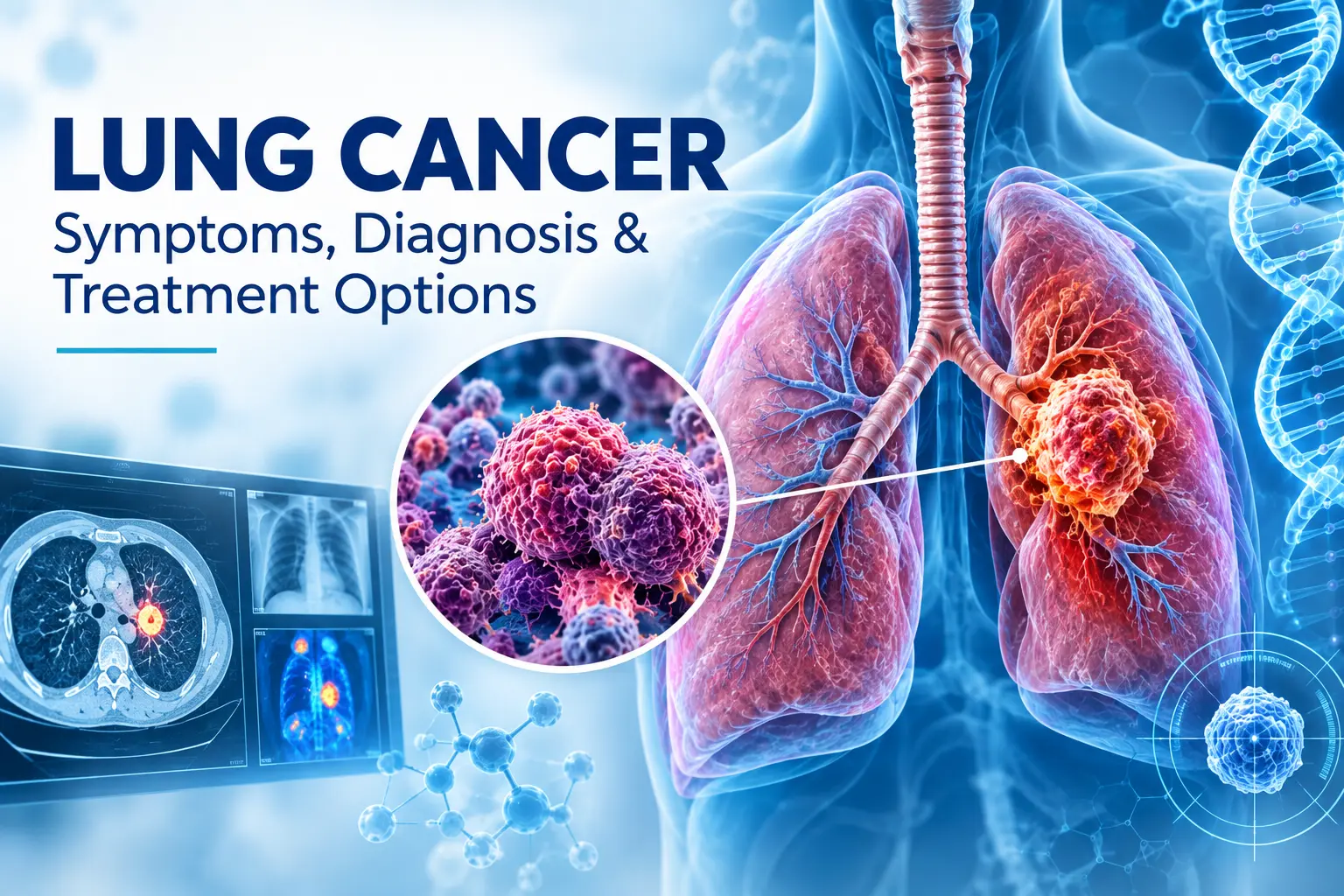
Lung Cancer: Symptoms, Causes, Diagnosis and Treatment Options
What Is Lung Cancer?
Lung cancer is a cancer that begins in the tissues of the lungs. The two main types are non-small cell lung cancer (NSCLC) and small cell lung cancer (SCLC). NSCLC is the more common type, while small cell lung cancer generally behaves differently and has its own treatment approaches.
Lung cancer can develop in people who smoke as well as people who have never smoked. Smoking is the most important known risk factor, but exposure to secondhand smoke, radon, certain workplace substances, air pollution, previous chest radiation and family history can also contribute to risk.
Treatment depends on the cancer type, stage, molecular characteristics, overall health and whether the tumor can be treated with surgery. Modern lung cancer care may involve surgery, chemotherapy, radiation therapy, immunotherapy and targeted therapy.
Types of Lung Cancer
Non-Small Cell Lung Cancer
Non-small cell lung cancer accounts for most lung cancer cases. Major subtypes include:
- Adenocarcinoma
- Squamous cell carcinoma
- Large cell carcinoma
Treatment varies according to tumor stage and molecular characteristics.
Small Cell Lung Cancer
Small cell lung cancer is less common but can grow and spread rapidly. Treatment is different from NSCLC and may include systemic therapy and radiation depending on the disease extent.
Causes and Risk Factors of Lung Cancer
Smoking tobacco is the most important risk factor for lung cancer. Risk increases with factors such as the number of cigarettes smoked and the number of years a person has smoked.
Other recognized risk factors include:
- Cigarette, cigar or pipe smoking
- Secondhand smoke exposure
- Radon exposure
- Asbestos and certain workplace chemicals
- Air pollution
- Previous radiation therapy to the chest
- Family history of lung cancer
- Increasing age
- Certain genetic factors
Having a risk factor does not mean someone will definitely develop lung cancer, and lung cancer can also occur in people without a known major risk factor.
Early Symptoms of Lung Cancer
Lung cancer may sometimes be discovered through chest imaging before symptoms become obvious.
Possible symptoms include:
- Persistent or worsening cough
- Coughing up blood
- Chest pain
- Shortness of breath
- Hoarseness
- Unexplained weight loss
- Fatigue
- Recurrent respiratory problems
- Loss of appetite
These symptoms can also result from infections, chronic lung conditions and other non-cancerous problems. Symptoms that persist or worsen should be medically evaluated rather than assumed to be cancer.
Persistent Cough
A cough that continues, changes in character or becomes progressively worse may require evaluation, particularly when accompanied by other symptoms.
Coughing Up Blood
Coughing up blood, known medically as hemoptysis, can occur with lung cancer but also has other possible causes. It should be assessed by a healthcare professional.
Chest Pain and Breathing Problems
A lung tumor can affect nearby tissues or structures and may contribute to chest discomfort or breathing difficulties. However, chest pain and shortness of breath have many possible causes.
How Is Lung Cancer Diagnosed?
There is no single test that diagnoses every case of cancer. Doctors may use medical history, physical examination, imaging, laboratory tests and biopsy to establish a diagnosis.
Common investigations may include:
Chest Imaging
Doctors may use:
- Chest X-ray
- CT scan
- PET/CT
- MRI in selected circumstances
Imaging can help identify suspicious lung abnormalities and determine whether cancer may have spread.
Bronchoscopy
During bronchoscopy, a physician uses a specialized instrument to examine the airways and may collect tissue or other samples.
Lung Biopsy
A biopsy involves collecting a sample of tissue for examination by a pathologist. Tissue analysis can help confirm cancer and identify its specific type.
Lung Cancer Pathology and Molecular Testing
Modern lung cancer treatment increasingly considers the molecular characteristics of the tumor.
Biomarker testing examines genes, proteins or other characteristics of cancer cells that may help guide treatment. For some patients with NSCLC, molecular testing can identify changes that may be targeted by specific therapies.
Depending on the cancer and clinical setting, testing may evaluate biomarkers such as:
- EGFR
- ALK
- ROS1
- BRAF
- KRAS
- MET
- RET
- NTRK
- HER2
- PD-L1
The appropriate testing panel depends on the cancer type, stage and clinical circumstances. Not every patient will have an actionable biomarker.
Lung Cancer Stages
Staging describes how extensive the cancer is and whether it has spread to other parts of the body. Stage information helps clinicians select appropriate treatment.
NSCLC is generally staged from Stage I through Stage IV, with additional subdivisions.
Broadly:
- Early-stage disease: cancer is confined to the lung or nearby structures.
- Locally advanced disease: cancer has spread to nearby tissues or lymph nodes.
- Metastatic disease: cancer has spread to distant organs.
Small cell lung cancer is commonly described as limited-stage or extensive-stage, reflecting how far the disease has spread.
Surgery for Lung Cancer
Surgery can be an important treatment for selected patients with localized lung cancer.
Possible surgical procedures include:
- Wedge resection
- Segmentectomy
- Lobectomy
- Pneumonectomy
The appropriate operation depends on tumor location, size, stage, lung function and overall health.
Surgery may sometimes be combined with chemotherapy, radiation, immunotherapy or targeted treatment depending on the clinical situation.
Chemotherapy for Lung Cancer
Chemotherapy uses medicines that kill cancer cells or prevent them from growing and dividing.
It may be used:
- Before surgery
- After surgery
- Together with radiation in selected cases
- For advanced disease
- For recurrent cancer
The chemotherapy regimen depends on the type and stage of lung cancer and the patient's individual circumstances.
Radiation Therapy
Radiation therapy uses high-energy radiation to damage cancer cells.
It may be used:
- As part of treatment for localized disease
- Before or after other treatments
- Together with chemotherapy in selected locally advanced cancers
- To treat specific metastatic sites
- To relieve symptoms caused by cancer
Radiation planning depends on tumor location and the surrounding healthy tissues.
Targeted Therapy for Lung Cancer
Targeted therapy focuses on specific molecular changes that help cancer cells grow or survive.
For example, some lung cancers contain an EGFR alteration that can be treated with an EGFR-targeted medicine. Other actionable alterations may involve ALK, ROS1, BRAF, KRAS, MET, RET, NTRK or HER2, depending on the tumor. Biomarker testing helps determine whether a patient may have a molecular target for an available treatment.
Targeted therapy is therefore not a universal treatment for all lung cancer patients. The appropriate medicine depends on the tumor's molecular profile and the specific indication.
Immunotherapy for Lung Cancer
Immunotherapy helps the immune system recognize and attack cancer cells.
Immune checkpoint inhibitors are an important component of treatment for selected lung cancer patients. Biomarkers such as PD-L1 can sometimes help inform treatment decisions, although treatment selection involves multiple clinical factors.
Immunotherapy may be used alone or together with other cancer treatments depending on the cancer type and stage.
Advanced and Metastatic Lung Cancer
Advanced lung cancer may involve nearby structures, lymph nodes or distant organs.
When cancer has spread, treatment may include:
- Targeted therapy when an actionable biomarker is present
- Immunotherapy
- Chemotherapy
- Radiation therapy
- Combinations of systemic treatments
- Clinical trials
- Supportive and palliative care
Treatment goals may include controlling cancer growth, reducing symptoms, maintaining function and supporting quality of life.
Recurrent Lung Cancer
Lung cancer can return after treatment. Recurrence may occur:
- In the original area
- In nearby lymph nodes
- In another part of the lung
- In distant organs
Evaluation of recurrent disease may involve new imaging, biopsy or molecular testing because the characteristics of the cancer can change over time. Biomarker testing may help identify treatment options in appropriate cases.
Lung Cancer Screening
Lung cancer screening is different from diagnostic testing.
For people at sufficiently high risk, low-dose CT (LDCT) is the screening method that has demonstrated a reduction in lung cancer mortality. Screening recommendations depend on age, smoking history and other risk criteria and can differ between countries and guidelines.
Screening is generally intended for people without symptoms who meet specific risk criteria. Someone with concerning symptoms needs diagnostic evaluation rather than relying on a screening program.
Supportive and Palliative Care
Supportive care can be provided alongside cancer treatment.
It may help manage:
- Cancer-related pain
- Shortness of breath
- Fatigue
- Appetite and nutrition problems
- Nausea
- Treatment-related side effects
- Emotional and psychological concerns
Palliative care focuses on symptom management and quality of life and can be appropriate at different stages of cancer care.
Lung Cancer FAQs
1. What is lung cancer?
Lung cancer is a malignant disease that begins in lung tissue.
2. What are the two main types of lung cancer?
The two main categories are non-small cell lung cancer and small cell lung cancer.
3. What is the biggest risk factor for lung cancer?
Tobacco smoking is the most important known risk factor.
4. Can nonsmokers develop lung cancer?
Yes. Lung cancer can occur in people who have never smoked.
5. What are common symptoms of lung cancer?
Possible symptoms include persistent cough, coughing up blood, chest pain, shortness of breath, hoarseness, fatigue and unexplained weight loss.
6. How is lung cancer diagnosed?
Doctors may use imaging, laboratory tests, bronchoscopy and biopsy depending on the situation.
7. Is a biopsy always needed?
A biopsy is often needed to confirm cancer and determine its type, although the exact diagnostic approach depends on the clinical situation.
8. What is biomarker testing?
It examines genes, proteins or other features of cancer cells that may help guide treatment selection.
9. Can lung cancer be treated with targeted therapy?
Some lung cancers with specific molecular alterations may be treated with targeted therapies.
10. What is immunotherapy?
Immunotherapy is a cancer treatment that helps the immune system fight cancer cells.
11. Can lung cancer be treated with surgery?
Surgery may be appropriate for selected patients, particularly with potentially resectable disease.
12. Is chemotherapy used for lung cancer?
Yes. Chemotherapy can be used in several lung cancer treatment settings.
13. Can lung cancer spread to other organs?
Yes. Advanced lung cancer can spread to distant organs.
14. What is metastatic lung cancer?
It refers to lung cancer that has spread to distant parts of the body.
15. Can lung cancer come back after treatment?
Yes. Lung cancer can recur, and treatment depends on where and how the cancer returns.
16. Is lung cancer screening available?
Low-dose CT screening is used for people who meet certain high-risk criteria.
17. Does everyone with lung cancer need the same treatment?
No. Treatment depends on cancer type, stage, molecular characteristics and individual clinical factors.
18. Can lung cancer occur without symptoms?
Yes. Some lung cancers are discovered incidentally through imaging before obvious symptoms develop.
19. Does smoking cessation still matter after a lung cancer diagnosis?
Stopping tobacco use can provide important health benefits and should be discussed with a healthcare professional.
20. Where can patients find international lung cancer treatment information?
Patients can consult qualified oncology teams and reliable medical information resources. Medicine availability and regulatory approvals may vary between countries.
Global Medicine Information & Support by RootAid Pharma
International Medicine Information for Cancer Care
RootAid Pharma can provide general educational information and international medicine support for patients, caregivers and healthcare-related inquiries.
Information may include:
- Generic medicine information
- Brand-name medicine information
- International availability
- Prescription-related requirements
- Oncology medicine information
- General treatment-related resources
- International patient assistance
RootAid Pharma should be understood as an international medicine information and support resource, not as the manufacturer of the medicines discussed.
Cancer medicines should only be selected and used under the guidance of an appropriately qualified healthcare professional.
Medical Disclaimer
This content is for general educational purposes only and does not replace professional medical advice, diagnosis or treatment. Lung cancer treatment should be determined by a qualified oncology team based on the cancer type, stage, pathology, biomarker results and individual patient factors. Medicine availability and regulatory approvals may vary by country.
Need help after reading this?
Talk to our support team for sourcing guidance, product availability, and global delivery assistance.