Esophageal Cancer: Symptoms, Diagnosis & Treatment
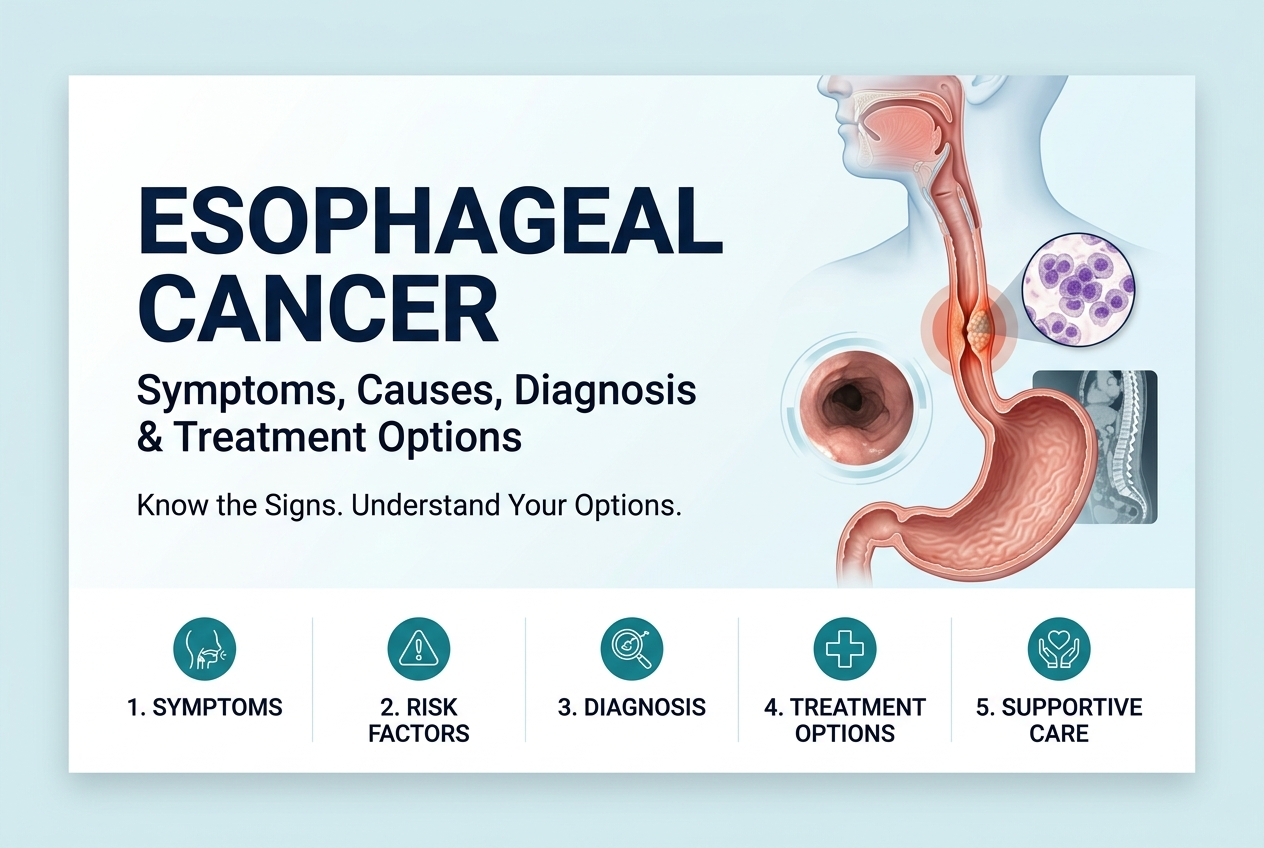
Esophageal Cancer: Symptoms, Causes, Diagnosis and Treatment Options
Esophageal cancer is a disease in which abnormal cells grow in the esophagus, the muscular tube that carries food and liquids from the throat to the stomach. The condition can interfere with swallowing and nutrition, and its symptoms may become more noticeable as the tumor grows.
The two most common types are esophageal adenocarcinoma and esophageal squamous cell carcinoma. They develop in different types of cells and may have different risk factors. Treatment depends on the cancer type, stage, tumor location, overall health, and whether the disease has spread.
Understanding the warning signs, diagnostic procedures, and available treatment approaches can help patients and caregivers prepare for discussions with a qualified healthcare team.
What Is Esophageal Cancer?
The esophagus is part of the digestive system. Its muscular walls move food toward the stomach through coordinated contractions. Esophageal cancer develops when cells lining or forming tissues of the esophagus undergo changes that allow them to grow abnormally.
As the tumor enlarges, it may narrow the passage through which food travels. This can lead to difficulty swallowing, discomfort when eating, and unintended weight loss. Some cancers are detected during evaluation for persistent digestive symptoms.
The diagnosis and treatment plan depend on the exact cancer type and how far it has grown. Some early cancers may be treated with endoscopic procedures, while others require surgery, chemotherapy, radiation therapy, immunotherapy, targeted medicines, or a combination of these approaches.
Types of Esophageal Cancer
1. Esophageal Adenocarcinoma
Adenocarcinoma develops from glandular cells and often occurs in the lower portion of the esophagus, near its connection with the stomach. Gastroesophageal reflux disease (GERD), Barrett's esophagus, excess body weight, and smoking are among the factors associated with increased risk.
2. Esophageal Squamous Cell Carcinoma
Squamous cell carcinoma begins in the flat cells lining the esophagus. It can occur in different parts of the esophagus. Tobacco use and heavy alcohol consumption are important risk factors, although patterns of risk vary across populations.
3. Other Rare Esophageal Tumors
Less common tumors can also develop in the esophagus, including certain neuroendocrine cancers, lymphomas, melanomas, and sarcomas. These diseases may require different diagnostic and treatment strategies.
Causes and Risk Factors of Esophageal Cancer
There is no single cause that explains every case. Factors associated with an increased risk include:
Tobacco use: Smoking and other forms of tobacco exposure increase the risk of esophageal cancer.
Alcohol consumption: Heavy alcohol use is associated with increased risk, particularly for squamous cell carcinoma.
Chronic acid reflux: Long-standing gastroesophageal reflux can contribute to Barrett's esophagus and increase the risk of adenocarcinoma.
Barrett's esophagus: This condition involves changes in the lining of the lower esophagus and is associated with a higher risk of adenocarcinoma.
Excess body weight: Obesity is associated with an increased risk of esophageal adenocarcinoma.
Increasing age: Risk generally increases as people get older.
Dietary and environmental factors: Certain dietary patterns, exposures, and regional factors may influence risk.
Having a risk factor does not mean that a person will definitely develop cancer. Some people diagnosed with esophageal cancer have no obvious risk factors.
Symptoms of Esophageal Cancer
Early esophageal cancer may not cause noticeable symptoms. As the disease progresses, possible signs include:
Difficulty swallowing food or liquids
Pain or discomfort when swallowing
A sensation that food is sticking in the chest or throat
Unexplained weight loss
Persistent discomfort behind the breastbone
Worsening indigestion or heartburn
Persistent cough or hoarseness
Reduced appetite
Fatigue, which may be associated with anemia or reduced nutrition
Difficulty swallowing that progressively worsens should be assessed promptly by a healthcare professional. Inability to swallow liquids or saliva, severe chest pain, or significant bleeding requires urgent medical attention.
These symptoms can occur for reasons other than cancer, so a medical evaluation is necessary to identify the cause.
How Is Esophageal Cancer Diagnosed?
Diagnosis usually involves a review of symptoms and medical history, examination, endoscopy, and tissue testing.
Upper Endoscopy
During an upper endoscopy, a clinician passes a thin, flexible tube with a camera through the mouth to inspect the esophagus and upper digestive tract. The procedure can identify suspicious areas and help guide tissue sampling.
Biopsy and Pathology
A biopsy collects a small sample of tissue for examination under a microscope. Pathology helps determine whether cancer is present and identifies the cancer type. Additional testing may be requested when it could influence treatment selection.
Imaging Tests
CT scans, PET/CT scans, and other imaging tests may be used to assess the tumor and investigate possible spread. Endoscopic ultrasound can help evaluate how deeply the tumor has grown into the esophageal wall and whether nearby lymph nodes are suspicious.
Biomarker Testing
For some advanced cancers, tumor testing can help identify treatment options. Depending on the cancer type and clinical setting, testing may include HER2, PD-L1, mismatch repair (MMR), microsatellite instability (MSI), or other relevant biomarkers.
Not every patient needs every test. The care team chooses investigations according to the diagnosis and treatment plan.
Understanding Esophageal Cancer Stages
Staging describes the extent of the cancer and helps guide treatment.
Stage 0: Abnormal cells are confined to the innermost lining and have not invaded deeper tissue.
Stage I: The cancer is relatively early and has invaded limited tissue layers.
Stage II: The tumor has grown more deeply or involves certain nearby lymph nodes.
Stage III: The cancer has more extensive local growth or regional lymph-node involvement.
Stage IV: The disease has spread to distant parts of the body.
The exact staging criteria depend on tumor type and clinical findings. Doctors consider imaging, biopsy results, tumor location, lymph nodes, and the patient's general health when planning treatment.
Esophageal Cancer Treatment Options
Treatment is individualized. The cancer's stage, type, location, biomarkers, nutritional status, and the patient's health all affect the recommended approach. More than one treatment may be used.
1. Endoscopic Treatment
Selected very early cancers or precancerous changes may be treated with procedures performed through an endoscope. These can include endoscopic mucosal resection, endoscopic submucosal dissection, or selected ablative techniques.
After endoscopic treatment, regular follow-up examinations may be necessary to check for remaining abnormal tissue or recurrence.
2. Surgery
An operation called an esophagectomy removes part or most of the esophagus, depending on the tumor and surgical plan. Nearby lymph nodes may also be removed. Surgery may be combined with chemotherapy, radiation therapy, or other treatments.
Not every patient is a candidate for surgery. The decision depends on the tumor's extent, overall health, and the expected benefits and risks.
3. Chemotherapy
Chemotherapy uses medicines that travel through the bloodstream to damage or destroy cancer cells. It may be given before surgery, after surgery, alongside radiation therapy, or as systemic treatment for advanced disease.
The medicines and treatment schedule depend on the cancer type, stage, previous therapy, kidney and liver function, and how well the patient can tolerate treatment.
4. Radiation Therapy
Radiation therapy uses high-energy radiation to damage cancer cells. It is often combined with chemotherapy for selected esophageal cancers. It may be used before surgery, as part of a treatment plan that does not include surgery, or to help relieve symptoms in advanced disease.
5. Immunotherapy
Immunotherapy helps the immune system recognize and attack cancer cells. Certain immune checkpoint inhibitors are used in selected settings of esophageal cancer, depending on cancer type, stage, prior treatment, and relevant biomarkers.
Immunotherapy is not suitable for every patient, and the expected benefits and possible immune-related side effects should be discussed with the treating oncologist.
6. Targeted Therapy
Targeted medicines act on specific molecules or pathways involved in cancer growth. For example, HER2-directed treatment may be considered for certain HER2-positive esophageal or gastroesophageal junction cancers. Other targeted approaches may be appropriate in particular clinical settings.
Biomarker results, disease type, treatment history, and local regulatory approvals help determine whether a targeted medicine is an option.
Advanced or Metastatic Esophageal Cancer
Metastatic esophageal cancer means the disease has spread beyond the original site to distant parts of the body. Treatment often focuses on controlling cancer growth, managing symptoms, supporting nutrition, and maintaining quality of life.
Depending on the cancer type and biomarker results, treatment may include chemotherapy, immunotherapy, targeted therapy, or combinations of these approaches. A clinician may also recommend radiation, an endoscopic procedure, or a stent to help with swallowing problems in selected cases.
Although advanced disease can be difficult to treat, care can still help control symptoms and may extend survival. Treatment goals vary by individual and should be discussed openly with the oncology team.
Nutrition and Supportive Care
Difficulty swallowing can make it hard for patients to maintain adequate nutrition and hydration. A dietitian or specialist care team may recommend changes in food texture, high-calorie nutrition support, or other measures based on the patient's needs.
Supportive care may also address pain, nausea, fatigue, anxiety, sleep problems, and treatment side effects. It can be provided alongside cancer-directed treatment and is not limited to end-of-life care.
Patients should tell their care team about worsening swallowing problems, dehydration, rapid weight loss, or difficulty maintaining food intake.
Esophageal Cancer Medicine Information
Cancer medicines are selected according to the tumor type, stage, biomarker profile, previous treatments, and the patient's overall health. Chemotherapy, immunotherapy, and targeted therapies each have different roles, benefits, and risks.
For example, HER2-directed medicines may be relevant for selected HER2-positive cancers, but they are not appropriate for every esophageal tumor. Testing and specialist assessment are necessary before a treatment is chosen.
RootAid Pharma provides general medicine information and international medicine-support guidance where available. It does not replace an oncologist's assessment or an individualized prescription. Availability and regulatory approval can vary by country.
Frequently Asked Questions About Esophageal Cancer
1. What is esophageal cancer?
It is cancer that develops in the esophagus, the tube that carries food from the throat to the stomach.
2. What are the most common types?
The two most common types are adenocarcinoma and squamous cell carcinoma.
3. What is the most common symptom?
Difficulty swallowing is a key symptom, particularly when it progressively worsens.
4. Can acid reflux cause esophageal cancer?
Long-standing reflux can contribute to Barrett's esophagus, which increases the risk of esophageal adenocarcinoma. Most people with reflux do not develop esophageal cancer.
5. Does smoking increase risk?
Yes. Tobacco use is an established risk factor.
6. How is esophageal cancer diagnosed?
Upper endoscopy and biopsy are central to diagnosis. Imaging and other tests help determine the extent of disease.
7. What is a biopsy?
A biopsy is a tissue sample examined under a microscope to identify cancer and its type.
8. Can esophageal cancer cause weight loss?
Yes. Difficulty swallowing, reduced appetite, and the disease itself can contribute to unintended weight loss.
9. Is surgery always necessary?
No. Treatment depends on the stage, tumor type, location, and whether surgery is appropriate.
10. What is chemotherapy?
Chemotherapy uses medicines that damage or destroy cancer cells and may be combined with other treatments.
11. Is immunotherapy used for esophageal cancer?
Yes. It is an option for selected patients, depending on the disease and treatment setting.
12. What is targeted therapy?
Targeted therapy acts on specific molecular features of cancer cells, such as HER2 in certain tumors.
13. Can esophageal cancer spread?
Yes. It can spread to lymph nodes and distant organs. Staging tests help assess its extent.
14. Why is biomarker testing important?
Biomarker testing can help identify treatments that may be appropriate for particular tumors.
15. What if swallowing becomes difficult?
Seek prompt medical evaluation. If the person cannot swallow liquids or saliva, urgent medical care is needed.
16. Can nutrition support help?
Yes. A dietitian and healthcare team can help address swallowing difficulties, weight loss, and hydration.
17. Can esophageal cancer return after treatment?
Recurrence can occur. Follow-up visits and recommended tests are important after treatment.
18. Does every patient need the same treatment?
No. Treatment depends on cancer type, stage, biomarkers, health status, and individual preferences.
19. Are clinical trials an option?
They may be an option for eligible patients. An oncologist can explain possible benefits, risks, and alternatives.
20. Where can patients find reliable treatment information?
A qualified oncology team and reputable cancer-information resources are appropriate starting points.
Global Medicine Information & Support by RootAid Pharma
RootAid Pharma shares general educational information about medicines and cancer-treatment categories for an international audience. This information can help patients and caregivers prepare questions for healthcare professionals.
Diagnosis, medicine selection, prescription decisions, dosing, monitoring, and treatment changes must be handled by qualified healthcare professionals. Medicine availability and approval may differ by country.
Medical Disclaimer
This article is for educational purposes only and is not a substitute for medical advice, diagnosis, or treatment. Symptoms described here can have causes other than cancer. Consult a qualified healthcare professional for assessment and individualized guidance. Do not start, stop, or change any cancer medicine without guidance from your treating clinician.
Need help after reading this?
Talk to our support team for sourcing guidance, product availability, and global delivery assistance.